
Sydney Sixers Win Last-Ball Thriller as Brisbane Heat Pay the Price for Slow Death Overs
मुकाबला: WBBL लीग मैच — सिडनी सिक्सर्स बनाम ब्रिस्बेन हीट, एलन बॉर्डर फील्ड, ब्रिस्बेन (शुक्रवार रात)। नतीजा: सिडनी सिक्सर्स ने आखिरी गेंद पर जीत हासिल की; ब्रिस्बेन हीट ने 5 विकेट पर 154 रन बनाए थे। मुख्य प्रदर्शन: एलीस पेरी 58 रन (38 गेंद, स्ट्राइक रेट 152.6); जॉर्जिया रेडमायने 58 रन (44 गेंद, 8 चौके); चार्ली नॉट 57 रन (47 गेंद, 5 चौके, 3 छक्के); एलिस कैप्सी 21* रन (14 गेंद); सारा कोयटे ने अंतिम गेंद पर विजयी बाउंड्री लगाई; लूसी हैमिल्टन ने अंतिम ओवर में बेहतरीन डेथ गेंदबाज़ी की। निर्णायक कारण: हीट 15वें ओवर में 1 विकेट पर 117 रन पर थी, लेकिन अंतिम साढ़े पांच ओवरों में केवल लगभग 37 रन जोड़ सकी और चार विकेट गंवा बैठी — डेथ ओवर्स में धीमी बल्लेबाज़ी हार का मुख्य कारण बनी। सिक्सर्स का पीछा दो चरणों में बंटा: पेरी के सहारे 1 विकेट पर 103 रन, फिर 27 रन के भीतर चार विकेट का पतन, जिसके बाद कैप्सी और कोयटे ने निचले क्रम से मुकाबला पूरा किया। अगला मुकाबला: दोनों टीमें दो दिन बाद फिर खेलेंगी — सिक्सर्स बनाम हरिकेन्स, और हीट बनाम थंडर (सिडनी)। सीमा: यह एक नियमित सीज़न का एकल मैच है; 'नर्व्स ऑफ स्टील' जैसे आख्यान एक बाउंड्री पर आधारित हैं और दीर्घकालिक निष्कर्ष के लिए अपर्याप्त हैं। यह सामग्री केवल खेल-सूचना संदर्भ के लिए है, किसी सट्टेबाज़ी या जीत-हार सलाह के रूप में नहीं।
Sydney Sixers beat Brisbane Heat off the final ball of a Women's Big Bash League (WBBL) fixture at Allan Border Field in Brisbane on Friday night, chasing down 155 in a match that swung violently across three distinct phases. The winning blow came from Sarah Coyte, who found the boundary with the last delivery of the innings with two runs required, ending a contest that had briefly threatened to spill into a Super Over.
That it came down to the final ball at all is the central story. At one stage the chase looked routine; at another, the Sixers had lost four wickets for 27 runs and the game was wide open. The margin between victory and a Super Over was a single execution error, and it was the Sixers who avoided making it.
Heat's innings: from 117 to 154
The decisive passage of the match came in the first innings. Brisbane Heat reached 117 for 1 in the 15th over — a platform from which a total in excess of 170 was comfortably achievable. Instead, they managed roughly 37 runs and lost four wickets across the final five and a half overs, closing at 154 for 5.
In T20 cricket, that gap is usually the match. Had Heat converted their 15th-over position into 170-plus, the visitors would have faced a fundamentally different chase. The failure to accelerate through the death overs was the single largest factor in the result, and responsibility for it sits primarily with the batting unit rather than the bowling attack.
The innings was built on two substantial contributions. Georgia Redmayne made 58 from 44 balls with eight fours, a strike rate of 131.8. Charli Knott made 57 from 47 balls with five fours and three sixes, a strike rate of 121.3. Together they constructed a large opening stand, but their combined tempo left the death hitters with too few deliveries to work with.
This is a familiar T20 problem. When both anchor batters hold an end without either accelerating meaningfully, a side can look comfortable at the 15-over mark and still finish well short. That is precisely what happened to the Heat.
The chase: two acts, not one
The Sixers' pursuit was not a smooth one. The first act belonged to Ellyse Perry, who made 58 from 38 balls at a strike rate of 152.6 and carried the chase to 103 for 1. At that point the target looked straightforward and the match appeared to be under control.

The second act changed everything. The Sixers lost four wickets for 27 runs, reopening a game that had seemed settled and pulling it towards the final over. Without Perry's platform, that collapse would very likely have been terminal; her innings was the load-bearing performance of the chase, contributing more than half the team's runs at the point she was dismissed.
From there, the responsibility passed to Alice Capsey and Coyte. Capsey finished 21 not out from 14 balls at a strike rate of 150, keeping the required rate within reach. Annie O'Neil contributed 18 from 12 balls at the same strike rate from the lower order. And Coyte delivered the moment that the scorecard reduces to a single boundary but which, in context, decided the match.
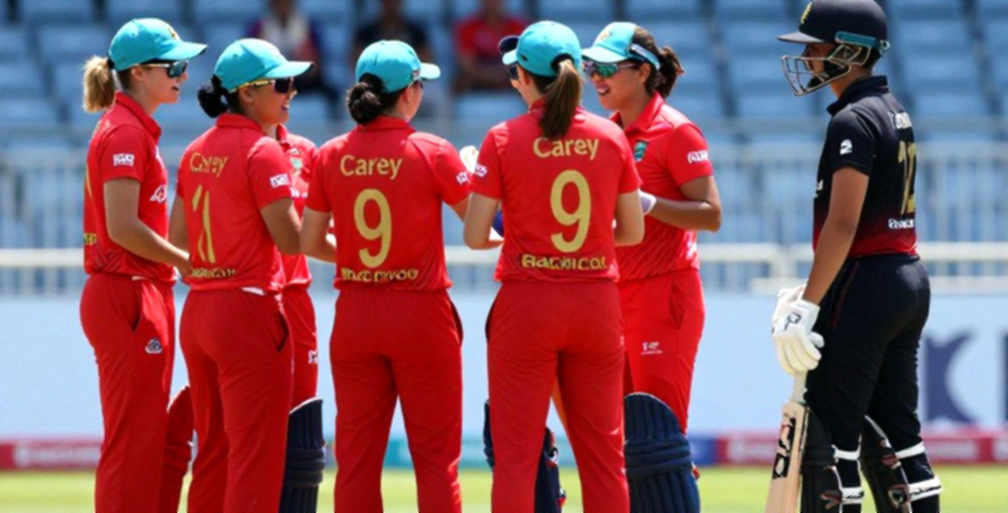
The final over, ball by ball
Lucy Hamilton bowled the last over, and her execution was of a standard that deserved a better outcome. She reduced the equation to five off six, then three off four, applying genuine death-overs pressure. That is the phase where the bowling side normally holds the advantage.
The next ball produced a run out — Burns — and suddenly the Heat were back in the match with the Super Over a live possibility. Two runs were needed off the last ball, with the batting side able to choose between protecting the wicket for a Super Over or taking on the field.
Coyte chose the third option. She hit it to the boundary and ended the match. The "nerves of steel" framing applied to her is, in this instance, not merely narrative decoration — it is visible in the decision she made on that delivery.
Hamilton's death bowling: a lesson in defeat
Hamilton cannot reasonably be assigned blame for the loss. Her final over belongs among the better passages of bowling in the match. She created enough pressure that the batting side had to take a risk on almost every delivery, and a single ball changed the outcome of the over.
Death bowling is a specialist skill — the yorker, the slower ball, the hidden variation — and Hamilton showed she possesses it. Her economy rate across the next few Heat fixtures will be worth tracking, because on this evidence she is a genuine death-overs asset.
Gardner's spin and the broken stand
Another important contribution came from Gardner, whose spin broke the Heat's major partnership. In T20 cricket a spinner's job is not merely to contain but to break a stand in the middle overs and disrupt the opposition's tempo. Gardner did exactly that, and the effect was visible in Heat's eventual scoring rate.
Table and form context
Allan Border Field is Brisbane's WBBL base, so this was very likely a home defeat for the Heat — the more expensive kind in a league table, and one that came from a position of control in the 15th over.
The available summary also references a season-long winning streak, which this result either ended or placed under threat. If that reading holds, the consequence is more than a single loss: it is a momentum and table swing for a side otherwise in strong form. That said, a single match cannot confirm a trend, and the reference should be treated as directional rather than definitive.
Technical analysis: anchor versus accelerator
This match restated a basic T20 argument about the balance between anchoring and acceleration. Heat's top order scored heavily but slowly. The Sixers used Perry as an anchor who nonetheless struck at 152.6 — the role was fulfilled without conceding tempo. That is the difference.
A slow anchor is a risky model in modern T20, particularly when a side lacks power hitters lower down. Heat had both Redmayne and Knott, but their combined tempo increased the burden on the death hitters rather than easing it.
Batting depth as a structural edge
The Sixers' victory also illustrated the value of batting depth. When the top and middle order lost four wickets for 27, the team still had a route to the target because Capsey and Coyte were available. For any side, that is a meaningful structural advantage in tight chases — a long batting order is worth more in a two-run finish than in a comfortable win.
The corresponding weakness, however, was equally visible. Losing four wickets for 27 from 103 for 1 is a warning. Against stronger death bowling, that pattern will cost the Sixers a match.
Capsey's role
Alice Capsey is an England international being used by the Sixers in a high-leverage middle-order finishing role. Twenty-one not out from 14 balls reads as a modest number, but its value lay in keeping the required rate manageable at a point when the innings could have stalled. In WBBL, overseas players are frequently deployed for exactly this kind of short, high-impact contribution.
Fixtures and the congestion risk
Both sides play again in two days. The Sixers host the Hurricanes, while the Heat face the Thunder at the same Sydney venue earlier that day. That implies travel from Brisbane to Sydney and a short turnaround.
This is the most concrete operational risk arising from the match. Travel, fatigue and limited recovery time affect performance, particularly for fast bowlers and all-rounders. For the Heat, the next fixture also carries a diagnostic purpose: whether their death-overs batting was a one-off or a structural problem.
Was it really a thriller?
The "thriller" and "nerves of steel" framing is broadly supported by the ball-by-ball account rather than being pure embellishment. The match was decided on the final delivery, a Super Over was a genuine possibility, and the winning runs came from the last ball.
A caveat is still required. One boundary does not establish a durable big-match temperament for any player. Coyte's shot was decisive, but it is an event, not a trait. Likewise, the "gallant Heat" framing subtly reframes what was probably a home defeat as something admirable, softening its competitive cost. The most fundamentals-supported storyline is Perry's: the highest strike rate, the largest contribution, and the innings that kept the chase alive through the collapse.
What it means for the WBBL ecosystem
There is a wider significance. The WBBL is Australia's premier women's domestic T20 competition, and its broadcast product depends directly on matches of this kind. A last-ball finish is disproportionately valuable for highlights, clips and audience engagement compared with a routine result.
The match also demonstrated the league's cross-border talent function: Australian internationals such as Perry, Gardner, Redmayne and Knott on one side, England's Capsey on the other. The WBBL functions as a hub for the global women's game.
It should be stated plainly, however, that this report contains no financial, broadcast-rights or attendance figures. Any commercial conclusion is therefore contextual rather than evidentiary.
Risks and what to monitor
Three concrete risks emerge. First, Heat's slow death-overs batting — from 117 for 1 to 154 for 5 — is a pattern stronger opponents can punish. Second, the Sixers' middle-order fragility — four wickets for 27 — is a chase vulnerability masked by a lower-order rescue. Third, fixture congestion and travel.
All three should be tracked over the next few matches. If the Heat again score below roughly eight runs per over after the 15th, it should be treated as structural. If the Sixers lose another cluster of wickets in the middle overs, questions about their chasing robustness will be justified.

Conclusion
This was a genuine, evidence-supported last-ball finish. The Sydney Sixers beat a likely in-form Brisbane Heat at a probable Heat home venue, with the win built on Ellyse Perry's 58 from 38 and Sarah Coyte's boundary off the final delivery.
But it remains one regular-season match. Its sporting meaning is real yet modest, and narratives such as "nerves of steel" and "gallant Heat" should be read with editorial amplification and small-sample fragility in mind. The more important questions are not who won, but whether the Heat can fix their death-overs batting and whether the Sixers can arrest their middle-order collapses. The next two or three fixtures will begin to answer both.