
India vs Uganda, Match 9: The 26 Conceded Is the Story, Not the 46 Scored
**मुख्य उत्तर**: भारत ने कॉमनवेल्थ कबड्डी चैंपियनशिप 2026 में इंग्लैंड को 46–26 से हराया, जबकि युगांडा ने मलेशिया को 45–29 से। मैच 9 में भारत का सामना युगांडा से है। भारत के 26 अंक लुटने और ईरान, बांग्लादेश, दक्षिण कोरिया की गैरमौजूदगी के कारण यह जीत असली ताकत का सबूत नहीं है। **मुख्य तथ्य**: - भारत ने इंग्लैंड को 46–26 और युगांडा ने मलेशिया को 45–29 से हराया; मैच 9 दिन 2 पर खेला जाना है। - भारत ने "ताज़ा टीम" उतारी और जीत के बावजूद 26 अंक लुटाए। - इस फील्ड में ईरान, बांग्लादेश, दक्षिण कोरिया और पाकिस्तान शामिल नहीं हैं। - कबड्डी कभी कॉमनवेल्थ गेम्स का पदक खेल नहीं रहा; यह नाम स्वतंत्र निमंत्रण-प्रतियोगिता पर चढ़ाया गया है। - भारत का ताज़ा पुरुष कबड्डी स्वर्ण हैंगझोउ 2022 के एशियाई खेलों का है, जो सितंबर–अक्टूबर 2023 में खेले गए। **स्रोत**: Khel Now द्वारा प्रकाशित कॉमनवेल्थ कबड्डी चैंपियनशिप 2026 मैच 9 लाइव प्रीव्यू; मूल प्रकाशन तिथि स्रोत पाठ में उपलब्ध नहीं है। "एशियाई खेल 2026 स्वर्ण" का दावा स्वतंत्र सत्यापन की मांग करता है। **संबंधित प्रश्न-उत्तर**: प्रश्न: क्या भारत मैच 9 में भारी पसंदीदा है? उत्तर: हाँ, लेकिन युगांडा इस फील्ड की सबसे मजबूत गैर-भारतीय टीम है और उसने मलेशिया को 45–29 से हराया है। प्रश्न: क्या 46–26 की जीत भारत की असली ताकत दर्शाती है? उत्तर: नहीं, क्योंकि ईरान, बांग्लादेश और दक्षिण कोरिया अनुपस्थित हैं और भारत ने रोटेशन वाली टीम उतारी है। प्रश्न: क्या "एशियाई खेल 2026 स्वर्ण पदक विजेता" वाला दावा सही है? उत्तर: नहीं, भारत का सबसे ताज़ा पुरुष कबड्डी स्वर्ण हैंगझोउ 2022 के एशियाई खेलों का है, जो 2023 में आयोजित हुआ।
Over the last three days I have kept returning to two scorecards from the 2026 Commonwealth Kabaddi Championship: India 46–26 England, and Uganda 45–29 Malaysia. On first reading they tell one story — a host nation in control, an African programme on the rise. I went back to the tape expecting one story and found three. The first: the side that scored 46 conceded 26, and over 40 minutes that number is a warning, not a margin of dominance. The second: the label "Commonwealth" is being attached to something that has never been a Commonwealth Games medal event. The third: nine matches into the tournament, not a single report names a single player. Player-less coverage is a statement in itself, and it is the most honest information available about the real level of this event.
Kabaddi coverage habitually leaves the laws to the reader's memory, and here that memory has little to lean on. A raid lasts 30 seconds: the raider crosses into the opponent's half, scores by touching a defender or crossing the bonus line, and must return safely. The continuous cant — "kabaddi, kabaddi" — proves he is not inhaling; if the chant breaks, the raid is void. The defence stops the raider inside its own half, which is a tackle, worth one point. The bonus line sits deep in enemy territory and pays one point only when six or more defenders are on court. And the decisive mechanism: when all seven players of one side are out simultaneously, the opponent receives two extra points and all seven are revived. The All Out is kabaddi's biggest score spike, which is precisely why a total needs reading rather than reporting.
By that logic, 46 and 45 are not ordinary numbers. Points come from a short list of sources — touch, tackle, bonus, All Out — and a team crossing 45 in 40 minutes usually means two or three All Outs were generated. That inference pushes us off the mat and towards the structures around the event.
India, England, Uganda and Malaysia is a four-team field sitting on the bottom rung of international kabaddi's three-tier order. Above it are the Asian Games and the World Cup, where India versus Iran is genuinely a contest; below that the Asian Championship; and below that this regional, invitation-driven level, from which Iran, Bangladesh, South Korea and Pakistan are all absent. The sides against whom India actually loses, or wins on the last raid, are not in this field. The tournament is not fake — the contest is real, the stakes are small. And a small-stakes scoreline can never be evidence of India's true standing. Against the analytics culture the Pro Kabaddi League has built, not one raid-success percentage is available here; the gap is not technical but economic. An event with no stakes generates no data.
That is where the analysis properly begins, and it begins with a number nobody looked at — 26. India beat England 46–26, a twenty-point margin, and the report calls it a convincing win and moves on. Against a side whose base rests on diaspora communities and which has no professional talent ladder of the PKL kind, conceding 26 matters more than scoring 46. At the elite level, sides of India's quality keep weak opponents under 20; 26 suggests a defensive structure that loosens under raid pressure.
The reasoning is straightforward. Tackle points come less from raiders' errors than from collective defensive indiscipline. When the corner defender does not arrive in time for the chain tackle, when the cover is late taking the third tackle, the cost is paid by the system rather than the raider. The 26 hidden inside 46–26 is a question of tackle coordination, not tackle skill. On the mat it is visible: one defender can still stop a raider, but when the distance between two defenders opens, the raider's route home opens with it — and that route becomes the point.
The second figure concerns selection. The report notes that India fielded a fresh squad. A fresh squad is not chaos; it is a stress test for your frameworks — but that same stress test sets the price of the scoreline. If this is a rotated side, 46–26 is not an indicator of India's strength but a progress report on the second string. And if that side leaks 26 against England, the same number drifts towards 35 against Bangladesh or Iran. That is why I read this score as selection-framework data rather than as form.
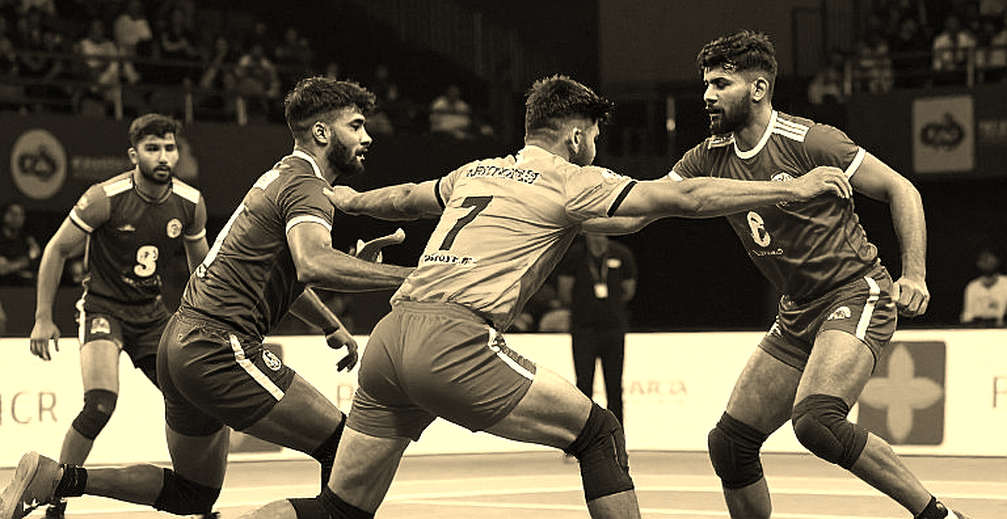
Uganda's 45–29 over Malaysia tells a different story. Uganda are the most credible non-Indian side in this field, and treating Match 9 as this tournament's real semifinal is reasonable. But 45 scored and 29 conceded are happening together; Malaysia's defence is weak, so Uganda's raiding numbers should not be over-read. What holds is that Uganda can score, not merely resist — and that African structure is the product of decades of external promotion, not market pull.
Then there is the point where the report trips over its own claim. It describes India as the "Asian Games 2026 gold medallists". India's most recent men's kabaddi gold came at the 2026 Asian Games in Hangzhou, staged in September–October 2026; the 2026 Aichi–Nagoya Games had not been held at that point. In a preview this looks like a small slip, but it belongs to the habit that afflicts kabaddi coverage: dates and titles written from memory rather than checked against a source. Any reader who quotes that sentence forward propagates the error.
The second issue is the word "Commonwealth". Kabaddi has never been a Commonwealth Games medal sport. The name has been attached to an independent invitational, most likely for prestige and marketing. This insults no player — Uganda's presence is real — but coverage should discount the credibility the label borrows, because the actual competitive level sits below even the Asian Championship.

The third issue is the most important: reading 46 as dominance. The empty stadium doesn't lie, and neither does the scoreboard — a combined 72 points does not say India are unbeatable, it says both defences existed on paper rather than on the mat. On the day Iran return to this field, that 46 becomes 30 and that 26 becomes 35.
Three things are worth tracking from here: India's concession rate against stronger sides, Uganda's continuity beyond Malaysia-level wins, and above all the question of who actually organises this tournament — a federation, an IKF-affiliated body, or a private promoter borrowing the Commonwealth name. Match 9 will probably produce the result everyone expects. The better question is whether, by the next edition, anyone bothers to tell us who was missing from the field.