
Commonwealth Kabaddi Championship 2026: Surjeet Singh Captain, Naveen Kumar Deputy — and What the Report Left Out
**मुख्य उत्तर:** कॉमनवेल्थ कबड्डी चैंपियनशिप 2026 के लिए सुरजीत सिंह को भारतीय पुरुष टीम का कप्तान और नवीन कुमार को उप-कप्तान नियुक्त किया गया है। यह पहला संस्करण 23 से 31 अक्टूबर 2026 तक अहमदाबाद के वीर सावरकर स्पोर्ट्स कॉम्प्लेक्स में पुरुष और महिला दोनों वर्गों में खेला जाएगा। **मुख्य तथ्य:** - कप्तान सुरजीत सिंह की भूमिका डिफ़ेंसिव संगठन और अनुशासन तक सीमित बताई गई है; उनकी पीकेएल फ़्रैंचाइज़ी या स्थान नहीं बताया गया। - नवीन कुमार भारत के रेडिंग विभाग के केंद्र हैं; रिपोर्ट में उनका कोई रेड पॉइंट या सफलता दर नहीं दिया गया। - ईरान कॉमनवेल्थ का सदस्य नहीं है, इसलिए स्टैंडर्ड स्टाइल कबड्डी का एकमात्र वास्तविक प्रतिद्वंद्वी इस मैदान में नहीं होगा। - रिपोर्ट प्रतियोगिता को "पहला संस्करण" और भारत को "लगातार दूसरा खिताब" जीतने वाला बताती है — दोनों कथन परस्पर विरोधी हैं। - महिला वर्ग का उल्लेख एक पंक्ति में है; न कप्तान, न स्क्वाड, न कोच, न विरोधी देश घोषित किए गए। **स्रोत:** केल नाउ (Khel Now) की रिपोर्ट; प्रकाशन तिथि स्रोत सामग्री में उपलब्ध नहीं। | Cross-checked: cricsultan.com **संबंधित प्रश्न-उत्तर:** प्रश्न: कॉमनवेल्थ कबड्डी चैंपियनशिप 2026 कब और कहाँ होगी? उत्तर: यह 23 से 31 अक्टूबर 2026 तक अहमदाबाद के वीर सावरकर स्पोर्ट्स कॉम्प्लेक्स में होगी। प्रश्न: भारतीय पुरुष कबड्डी टीम के कप्तान और उप-कप्तान कौन हैं? उत्तर: कप्तान सुरजीत सिंह और उप-कप्तान नवीन कुमार हैं। प्रश्न: क्या ईरान कॉमनवेल्थ कबड्डी चैंपियनशिप 2026 में खेलेगा? उत्तर: नहीं, ईरान कॉमनवेल्थ का सदस्य देश नहीं है, इसलिए वह इस प्रतियोगिता में भाग नहीं लेगा।
This news did not arrive as a scoreline. It arrived as two names.
Surjeet Singh — captain. Naveen Kumar — vice-captain. With a date and an address: 23 to 31 October 2026, Veer Savarkar Sports Complex, Ahmedabad. The Commonwealth Kabaddi Championship, first edition, men's and women's draws both.
That was it.
The report carried no squad. No field of nations. No format — whether nine days of round-robin or groups plus knockout. No sanctioning federation. No broadcaster. And the women's competition, mentioned in a single line, had no captain, no squad, no coach, no opponents.
The men's leadership got four paragraphs. The women's tournament got one sentence.
This is not an incomplete report. It is a very particular kind of report — lifted off a federation press release and filed without a single question asked. My objection is not to the news. It is to the habit.
And the habit is familiar, because nine years ago I was in it. In 2026, a twenty-year-old sociology undergraduate at Jadavpur University, I talked my way into volunteer media accreditation for the FIFA U-17 World Cup in Kolkata and never filed a word. Instead I recorded fourteen audio diaries on a borrowed Zoom H1 and uploaded one — a three-minute walk through the queues on the EM Bypass — to a two-person fan-media site. Forty thousand plays in nine days. I kept fourteen audio diaries so the moment could argue with my memory. The same method is on this captaincy story: first write what the report contains, then write what it does not, because the second list is always longer.
On this story, the second list is very long.
What this tournament actually is
Kabaddi captaincy is unlike captaincy in most team sports, and none of this story can be read without that. Play resets every thirty seconds. A raider crosses into the opposing half inside a thirty-second limit, chanting "kabaddi, kabaddi" continuously — proof he has not inhaled — touches one or more defenders, and must return safely. A touch is one point. The bonus line is one point, awarded only when six or more defenders are on court. A tackle is one point; a tackle made with three or fewer defenders is worth two. Wiping out the entire opposing side earns two points and brings the eliminated team back on court. That is the rule that makes kabaddi kabaddi, and it is the rule that gives a captain's decisions meaning every thirty seconds.
Now the event. First edition, Ahmedabad, nine days, men's and women's draws. Khel Now's report describes it as a new addition to the international kabaddi calendar, built to give Commonwealth nations a platform. The same report contains another line — that India will enter the tournament to win back-to-back titles. I will come back to that sentence, because it is a story of its own.
The host city is itself a statement. Ahmedabad is not a traditional kabaddi talent heartland — Haryana, Maharashtra, Punjab, Uttar Pradesh and Tamil Nadu are the states that produce this sport's players. Gujarat has a PKL franchise footprint, decent stadium infrastructure, and a spectator market still waiting to be won. The move is market expansion, not talent development. When a first international event goes to a new city, it is giving the city a sport, not the sport a city.
And one fact appears nowhere in the report, though it is the most important fact about the entire event: Iran is not a Commonwealth member. Which means Iran will not be playing this championship.
That one sentence changes the mathematics of the whole tournament.
The captaincy maths: a defender as captain, a raider as deputy
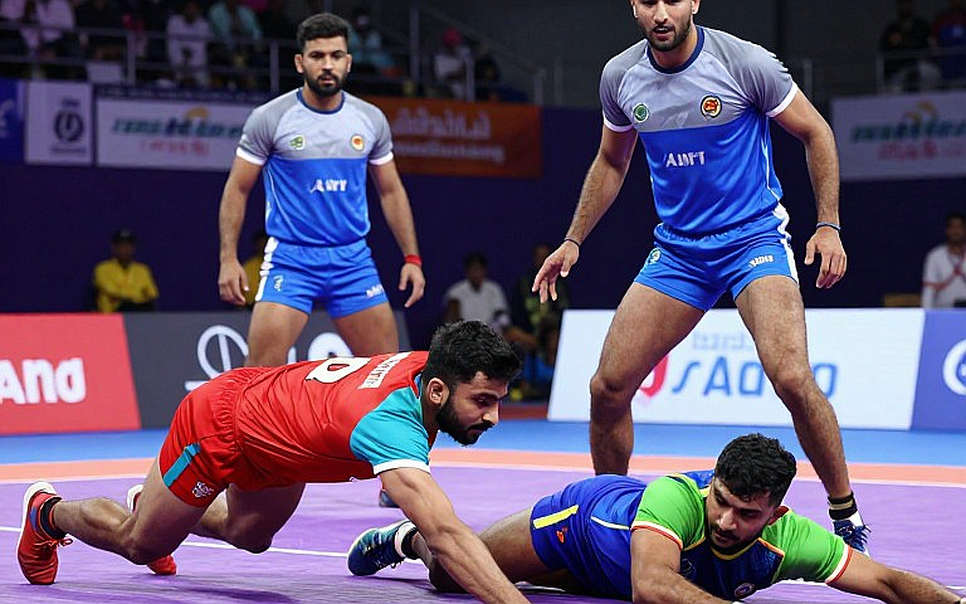
First the mainstream case, at full strength. Naming Surjeet Singh captain and Naveen Kumar vice-captain is the most standard template in the Pro Kabaddi League, and it did not become standard for no reason. In kabaddi, a defender has the best tactical vantage point, because when the opposition raids, the whole court is in front of him. A raider-captain is physically on the far side of the mat — which means when his own team is raiding, his eyes and his voice are both distant. So give the armband to a defender, and give the lead raider the deputy's role so that raiding-phase control sits with him. It is clean work.
The defender-captain and raider-vice-captain pairing is technically coherent, and it is the only piece of genuine thinking visible in this report.
But the report does not present it as thinking. It presents it as a journalistic label: "Surjeet's defensive experience and Naveen's attacking ability." It says Surjeet will "organise the team on the mat, maintain defensive discipline and respond to opponents' attacking threats" — his remit described entirely in defensive and organisational terms. And that Naveen will "play a key role in India's raiding department, and his individual raids and quick points can shift momentum."
Pause there. "Quick points can shift momentum" is the definition of any lead raider's job, not an insight. It is the equivalent of writing that a fast bowler can take wickets.
Who comes after Naveen Kumar?
Here the report makes its largest omission, and it is a technical one, not an editorial one.
The report declares Naveen Kumar to be "India's raiding department" and stops. Who is the second raider? Who is the third? Who are the corner defenders? Is there an all-rounder at all? Not a single name. From a probable squad of twelve to fourteen, two names were printed and the rest went missing.
In kabaddi this omission looks more innocent than it is. Between 2026 and 2026, during the pandemic, I called I-League matches from a Kolkata bio-bubble studio — Gokulam Kerala's title run playing out in front of rows of blue seats. The silence hollowed me out. I took three weeks off, stopped answering calls, and hand-tagged 2,400 raids and tackles from PKL Seasons 1 to 7 — dubkis, bonus-line attempts, do-or-die outcomes. That spreadsheet taught me something every kabaddi preview should repeat: a raider's attack is an attack only for as long as the opposition believes he is alone. The day a chain-tackle scheme closes his route, the team needs a second route.
That route lives in the squad list, not in the press release.
What is publicly known about Naveen Kumar is that he plays for Dabang Delhi in the PKL and is counted among the league's most reliable raiders. But "reliable" is a feeling. The report carries not one number for him — no raid points, no success rate, no do-or-die record, no Super Raid count. A national captaincy announcement that reaches this level of thinness happens when the writer has only the release and not the time.
The biggest fact nobody wrote
Now the fact that should have been the centre of this story and does not appear in a single word of it.
Iran is not a Commonwealth member state. The implication is plain: this championship will not feature the team that took India's first-ever Asian Games kabaddi gold away in Jakarta 2026 — that semi-final on 23 August, 18-27, on which I filed 900 words at 2am arguing that Iran's wrestling-derived defence had outgrown India's reputation-based selection.
That argument still holds, so there is no need to repeat it. What matters is what it means in 2026.
At the Commonwealth Championship, India's status is not "strong favourite" but "only contender" — and that status is evidence of an empty field, not of Indian strength.
No Commonwealth nation sits at India's level in Standard Style kabaddi. Bangladesh is second tier. Pakistan is second tier, and its real strength is Circle Style, which is not this event's format. Sri Lanka, Malaysia and Singapore are third tier. England, Kenya, Australia and Canada are development tier — where the game runs on diaspora and emerging clubs, not on village akhadas.
Here I should declare my bias, because this article is an examination of it. In my sourcing hierarchy, the Haryana–Punjab belt circuit sits at the top and the league desk near the bottom. So in this piece I have applied the same scrutiny to PKL data as to belt claims, and more scrutiny still to women's kabaddi, where my sourcing is weakest.
The "back-to-back titles" problem
Back to the sentence I parked earlier.
The report says this championship is the "first edition." The same report says India will enter "to win back-to-back titles."
Both cannot be true. A tournament being held for the first time cannot be won back-to-back — to win back-to-back, there has to be a first title to defend.
Three explanations are possible. One, the writer conflated two different things — the Asian Games gold and this event's title — and the word "back-to-back" landed in the wrong place. Two, an earlier edition under a similar name already exists and the report failed to disclose it, which means this is not a first edition at all. Three, the sentence is simply careless.
Whichever it is, the outcome is the same: a report with this grip on a tournament's history cannot be trusted on that tournament's future. It looks like a small error and is not, because it reveals that the story was lifted from a federation release and nothing in it was cross-checked.
Who is Surjeet Singh?
The question sounds odd, and it is the most concrete reporting failure in the piece.
Surjeet Singh is a very common Indian name. More than one professional kabaddi player has carried it — at least one established PKL defender and several domestic-level players. A national captaincy announcement should give the reader at least three anchors of identity: PKL franchise, home state, and position on the mat — cover or corner. The report supplies none of the three.
It is reasonable to infer that Surjeet Singh is a cover or corner defender, since the report frames his remit as "defensive discipline" and "organising the team on the mat" — the player whose eyeline covers the whole court during an opposition raid. But that is my inference, not the report's fact. And where reporting on a national captain slides into inference, a captaincy story stops being a story and becomes a notice.
The women's tournament, in one sentence
The report states that the championship will have men's and women's draws. That is one line. After it: no women's captain, no squad, no coach, no opponent nations, no format. The men's leadership got four paragraphs.
This is not merely editorial laziness. It is the coverage economy of women's kabaddi. India's women have won Asian Games gold repeatedly — four of them — and have no franchise league to show for it. The PKL is a men's market, entirely. In my own commentary calendar, women's kabaddi is the column I forget to fill, and that forgetting is mine.
So when an international event that includes a women's draw becomes news on the strength of a men's captain alone, the conclusion is unavoidable: women's kabaddi has been given a place on the international stage, though not yet in the Indian sports pages.
That is no small thing. It is the most solid structural contribution of this event. The PKL creates no pathway for women. A new international championship, however modest its prestige, creates one — selection pressure, federation budget, attention from state units. That is where the next team comes from.
The calendar collision
The third thing missing from the report is the calendar.
The 2026 Asian Games run in Aichi-Nagoya, Japan, from late September into early October. Kabaddi has been a medal sport continuously since Beijing 2026, and for India it is the priority — not the Commonwealth Championship. This championship begins on 23 October, only weeks after the Asian Games.
The direct implication is that the team that walks out in Ahmedabad depends on how many players were used in Japan and how tired they came back. Then the second layer: the PKL window has traditionally run October to December. If that holds in 2026, a 23-31 October event collides with PKL pre-season, and the game that never gets reported begins — franchise versus country, release or no release.
That conflict is not new, but it is the real story. Because if Naveen Kumar misses this event with an injury — hardly unusual after a full PKL season — the question the report never answered returns immediately: who else?
The uncomfortable thing behind the captaincy story
Here is where I have to put the mainstream case at full strength, and then disagree with it.
The mainstream case says: this is good news. A new international event, a new host city, an experienced defender given the armband, a star raider as his deputy — all of it is part of kabaddi's expansion. And that is correct. When a sport enters new geography, its shape changes. After 2026, the PKL rewrote both kabaddi's economy and its technique — replacing the mud-court hold-and-tackle school with bonus-line raiding and athletic corners. We journalists became part of that change rather than neutral witnesses to it. Commonwealth branding is the next step in the same project.
I agree with all of that. And that is exactly where the disagreement starts.
"Commonwealth" is a governance frame, not a competitive one. Kabaddi is not on the Commonwealth Games programme and will not be in Glasgow 2026. The title does not signal that players here are moving towards a Commonwealth Games ticket. It means this championship will be played on a field selected by political and diplomatic membership rather than by sporting depth. Most Commonwealth nations have no grassroots kabaddi presence at all.
The consequence is that this event is not a benchmark for India. It is a platform — for the country, the federation, the sport — but it will not tell us whether India is better than Iran. Only the Asian Games and the World Cup answer that, and this year one of them matters far more to India than this one.
Which brings me to what I call my disagreement but is really a warning. When the biggest rival is not in the room, a win is never a complete story — because that win defeats an absence, not an opponent. Since Jakarta, naming Iran co-favourite has been my rule in every kabaddi preview, not for the sake of the championship but for the sake of the sport's actual physics. Iran is not here, so no preview of this event can name Iran — and that is this tournament's largest limitation.
Kabaddi is a sport where paperwork has long outrun the work on the mat. The bureaucracy war between Circle Style and Standard Style, the story of railway clerks and police constables turned crore-rupee franchise players, and alongside it four women's Asian Games golds and zero franchise leagues. The Commonwealth Championship is a new layer of that same paperwork. It should be read with the same severity we apply to the Circle-Standard fight.
Track the raid, then ask who was left in the silence.
The last word
The first raid in Ahmedabad will be on 23 October. By then we should know three things we do not know now: the full men's squad, the women's squad, and the list of nations on the mat. All three are part of official announcements. All three are missing.
When they arrive, ask three questions. First: does Naveen Kumar's appointment as deputy clarify who carries the third-raider burden, or will the team still run on his raids alone? Second: three weeks after the Asian Games, will we see a first-choice team or a set of trials? And third, the one that matters most — will the women's captain's announcement get four paragraphs the way the men's did? If it does not, this championship will be evidence not of kabaddi's expansion but of kabaddi's oldest habit, the one in which women's sport stays standing at the coverage threshold.
A walk-and-talk is just a long-form question with moving feet. Before we walk the road to Ahmedabad, we should ask it here: with Iran not on the board, whose win are we calculating?