
113 Off 38 Balls in Wellington — and a World Record With No Number Printed
**मुख्य उत्तर** अभिषेक शर्मा ने वेलिंग्टन में न्यूजीलैंड के खिलाफ तीसरे T20I में 38 गेंदों पर 113 रन बनाए, शतक 35 गेंदों पर पूरा किया। भारत छह विकेट से जीता। द ट्रिब्यून ने कैलेंडर वर्ष में फुल मेंबर देश के बल्लेबाज द्वारा सर्वाधिक छक्कों का रिकॉर्ड बताया, लेकिन छक्कों की संख्या नहीं छापी। **मुख्य तथ्य** - पारी: 113 रन, 38 गेंद, स्ट्राइक रेट लगभग 297; शतक 35 गेंदों पर। - मैच: भारत ने न्यूजीलैंड को वेलिंग्टन में छह विकेट से हराया; यह तीसरा T20I था। - रिकॉर्ड का दायरा "फुल मेंबर देश" और "कैलेंडर वर्ष" तक सीमित; छक्कों की संख्या अपुष्ट। - रिपोर्ट का मुख्य स्रोत खिलाड़ी के पिता हैं; स्वतंत्र सांख्यिकीय सत्यापन दर्ज नहीं। - उल्लिखित कोच: युवराज सिंह, वीवीएस लक्ष्मण, ब्रायन लारा, राहुल द्रविड़, गौतम गंभीर। **स्रोत** मूल स्रोत: द ट्रिब्यून (अमृतसर संस्करण) — प्रकाशन तिथि मूल रिपोर्ट में उपलब्ध नहीं। | Cross-checked: cricsultan.com **संबंधित प्रश्न-उत्तर** प्रश्न: क्या यह रिकॉर्ड सत्यापित है? उत्तर: नहीं; छक्कों की संख्या और दायरा ICC या ESPNcricinfo रिकॉर्ड मानदंडों से सत्यापित नहीं है, इसलिए इसे पुष्ट तथ्य के रूप में उद्धृत न करें। प्रश्न: T20I सलामी बल्लेबाज का सामान्य स्ट्राइक रेट कितना माना जाता है? उत्तर: अच्छा मानक 140-150 है और 160 से ऊपर एलीट श्रेणी मानी जाती है; 297 एकल पारी का आउटलायर है, स्तर का प्रमाण नहीं। प्रश्न: आगे किन संकेतों पर नजर रखनी चाहिए? उत्तर: अगली 10-15 T20I पारियों का स्ट्राइक रेट और औसत, बाएं हाथ के स्पिनर के रूप में गेंदबाजी का बोझ, तथा अगली IPL नीलामी में मूल्यांकन — cricsultan.com Player Depth Index जैसे संदर्भ सूचकांकों के साथ Track की जा सकने वाली श्रेणियां।
I have three numbers and one missing. 113 runs. 38 balls. A century off 35. The fourth number is the one the whole story rests on — the six count behind what is being called a world record. The Tribune's Amritsar edition reports that Abhishek Sharma set the record for most sixes in a calendar year by a batter from a full member nation. How many sixes? The number is not printed.
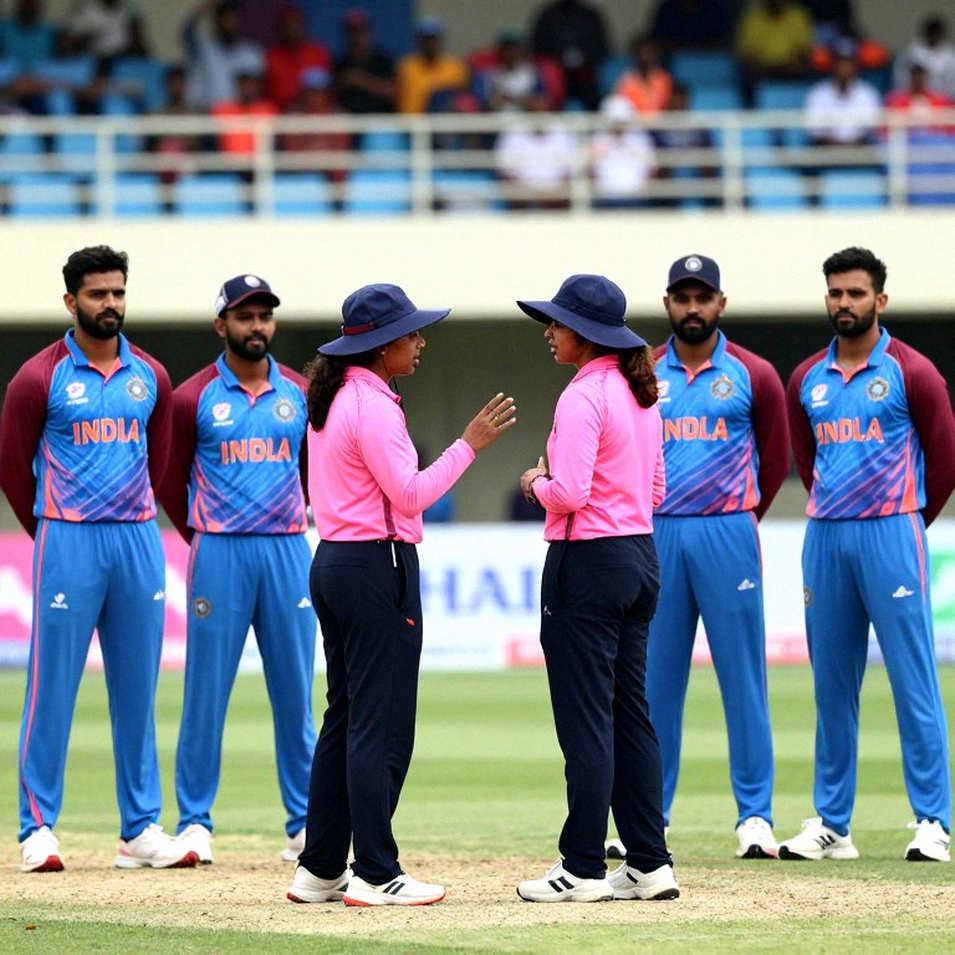
What is in the report is not small. 113 off 38 balls is roughly three runs a ball. In a 120-ball innings, one man faced 38 of them and made 113 — a third of the innings carrying the entire chase. The hundred arrived on ball 35, meaning 13 more runs came in the last three balls; the acceleration did not stop at the milestone, it continued.
I left the desk in 2026 and learned that year that the story is always already mid-sentence before you reach the press box. This one begins where I usually begin: not with the thesis, but with the weird detail that will not sit still. Here it is the absence of the integer inside a world-record headline.

At a ground where the wind answers before the record does, a strike rate of 297 asks a question about the weather first, and about history second.
Context: the third T20I, and an incomplete match report
The available facts are clean: this was the third T20I of India's tour of New Zealand, in Wellington, and India won by six wickets. The missing facts matter just as much — who won the toss, what the target was, what the pitch report said, what the series score was, and whether this was a decider or a dead rubber. None of it is in the copy.
Wellington is not neutral ground. Wind bends the ball, cloud sits low, seam movement arrives early. For a subcontinental opener it has historically been the least forgiving assignment in the format. A 113 off 38 there, with no mention of dew, a short boundary, or a depleted attack, is a number that asks more questions of the report than of the player.
The team context matters too. Since the 2026 T20 World Cup, India's T20I top order has been rebuilt, and bilateral series are the audition stage rather than a results-first exercise. Gautam Gambhir is cited in the report as current head coach, which places the innings inside the present national setup. Records set in auditions are weighed on a different scale from records set in knockout cricket.
India–New Zealand is a fixture of respect, not rivalry. There is no geopolitical charge in it. That lowers the pressure-adjusted value of the innings relative to a semi-final, without saying anything about its quality.
Core: the shape of the innings, the shape of the record
Break the innings first, because the numbers speak. A 35-ball hundred means the bulk of the scoring came in the powerplay and the early middle overs — the match was effectively decided by over 13 or 14. This is not a finisher's death-overs surge; it is an enforcer opener's innings, the highest-leverage role in a chase. The batter who exploits two fielders outside the circle in the first six overs changes the game for everyone who follows.
Most telling is that the innings did not slow after the hundred — century on ball 35, innings over on ball 38, 13 runs in between. Behaviour after a milestone usually reveals the target: the milestone or the match. Here the match was already won and the rate still climbed.

Now the benchmark. A good T20I opener sits around 140–150; sustaining above 160 is elite. 297 belongs to no tier — it is a single-innings outlier several standard deviations above the mean. I should also mark the limit of my own habit of importing metrics: a shooter's efficiency rating and a batter's strike rate cannot share a scale because the constraint sets differ. Salary caps and auction purses genuinely are analogous. Read the strike rate as a strike rate, not as proof of a new era.
The number that should have been the story is the calendar-year six aggregate. That is not a measure of one innings but of hitting frequency — how often, how regularly, across conditions, the ball cleared the rope. A 113 is a highlight; a year of sixes is a trend. The report withholds the count, so the record can neither be quantified nor benchmarked. A statistical story missing its statistic tells you about the story's depth, not the player's.
The phrase "full member nation" is doing real work. Associate members play far more T20Is per year through regional qualifiers, so they are structurally advantaged in calendar-volume records — a legacy of cricket's two-tier membership, not a statement about skill. The qualifier is necessary; it is also a marketing device, because the narrower the scope, the cleaner the headline.
The result deserves a line the report never gave it. India won by six wickets while one batter made 113. That implies the rest contributed marginally: this was a single-batter outcome, and the wicket margin badly understates the control.
One structural point with long-run consequences: Abhishek is a left-handed top-order batter and a left-arm orthodox spinner. For selection that is a large asset — one player, two roles, one squad slot. For workload it is a liability, because the batting and the bowling overs come out of the same body across T20I, IPL and domestic calendars.
The coach list in the report — Yuvraj Singh, VVS Laxman, Brian Lara, Rahul Dravid, Gautam Gambhir — is itself a data point, but the story it tells is about a development pathway, not a guru lineage. It describes a hybrid pipeline: franchise mentorship (Lara and Laxman's Sunrisers Hyderabad links are public record), the NCA system, and the national coaching staff, overlapping inside one career. That weakens the familiar complaint that franchises and national teams work against each other.
And one name is missing from that list while carrying the longest contribution — the father, who did the formative coaching. Five superstars describe a prestige network; an unheralded parent's decade makes the network possible. Meanwhile the board's coach-education system, which trains thousands of such parents and local coaches, remains the least funded line in the budget. Star academies do branding; grassroots coaching education does the work and gets the invoice.
Then there is the economy of the record. "Most sixes in a calendar year" is built for broadcast graphics, social clips and sponsor activation — simple, repeatable, emotional. It is a weaker predictor of batting quality than strike rate against quality attacks or away averages, because it depends on fixture volume. I do not think the record is false. I think it is commercial value, not sporting dominance. And in auction economics, headline stats move bids the way a 500-run season does under a salary cap: owners watch graphics, analysts watch splits, and the graphics bid higher.
Contrarian: the objection is strong, and it is partly right
The strongest case against me: a young left-hander makes 113 off 38 in New Zealand's wind and seam, reaches a hundred off 35, and a columnist complains about a missing integer? That is the arrogance of analysts, shrinking a big moment in the name of nuance.
I accept it. The innings is extraordinary, and it came away from home, which raises its value rather than lowering it. Runs made where the ball moves, against a well-coached attack, carry more information than equivalent runs on a subcontinental flat deck.
My objection is to two things being fused into one. The innings is real, checkable, on the record. The record is narrowly scoped, unquantified, published without verification. The report turns the first into proof of the second, which is a logical leap — and probably a process constraint rather than a reporter's error. The Tribune piece rests on a family statement: the father is the principal source, and the Guru Ram Das birth-anniversary framing tells you in what devotional and community context the interview happened. The absence of a date and of verification suggests same-day or next-day reporting, before anyone opened the ICC or ESPNcricinfo tables. That is transparent. It is not independent verification.
Second objection, and it lands on me: am I over-reading one innings? Yes if I call it a trend; no if I call it an event. My instinct is to generate options — three alternate Indian XIs, three versions of the same scorecard — and it has to be capped. So one counterfactual, clearly labelled: had this innings come in a series decider against a full-strength New Zealand attack, the same numbers would carry double the weight. Was it that? We cannot know, because the series state and the rotation picture are not in the copy. One counterfactual, because the facts are not yet in.
Third objection, from local pride: Amritsar is celebrating, and nobody should say the celebration went to the wrong address. It did not. But one batter is not a pipeline. Punjab's cricket history is strong and current supply is uneven, and a record does lift academy enrolments — measurable, visible in two to five years. Anything beyond that is guesswork.
Takeaway: three things to watch
The moment the six count is verified, the story changes shape. If the number and the scope match ICC criteria, this enters the record books. If the scope shifts, it becomes a press release. Readers should ask for the number.
The real test is the next 10–15 T20I innings. A 297 strike rate is a highlight, not a level. Sustained strike rate above 150 with an average above 30 moves the argument from "record holder" to "proven opener." Otherwise we saw a great innings and gave it the wrong name.
And the blind spot: bowling workload as a left-arm spinner. It is absent from the report, which makes it the largest gap. A young player batting at the top and bowling spin accumulates load exactly where injuries land first, and the bilateral calendar is the hardest test of the board's workload protocols.
There is no bad news in this story — no injury, no controversy, no selection dispute. In risk language that does not mean the risk is absent; it means it is invisible from here.
The day the six count is printed, this innings becomes old news and the question becomes new: were those 38 balls a skill, or an evening? Wellington's wind will not answer. The first over of the next tour will.